
The Fly Ash and Slag Alternative
For decades, fly ash and granulated blast-furnace slag (also known as just "slag") have been two of the primary supplementary cementitious materials, or SCMs, used in concrete.
But ready-mix plants are now facing a problem: fly ash and slag are disappearing because they are byproducts of industries that are dying in the United States.
Fly Ash
Fly ash comes from coal-fired power generation. As coal power changes, the supply of fresh, concrete-grade fly ash is becoming unstable.
The U.S. Energy Information Administration tracks coal production, consumption, and electric power data in its Monthly Energy Review, which is a useful source for understanding long-term fly ash supply risk.
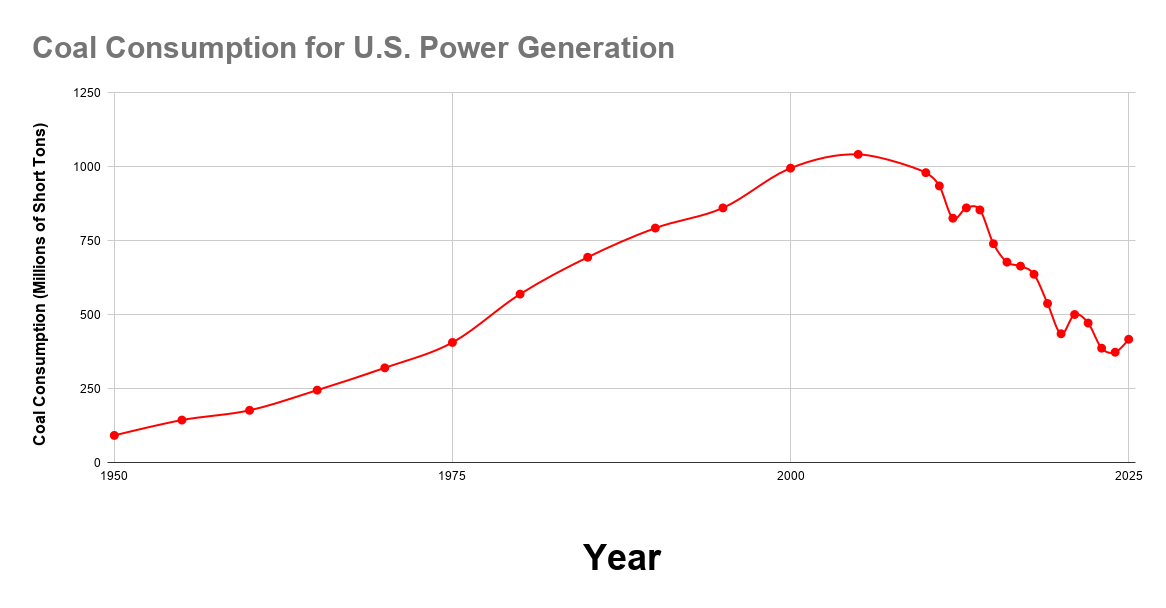
Coal consumption for US power generation in (millions of short tons). This is a proxy for fly ash supply in the US since exact measures are rare. Source: EIA Monthly Energy Review.
Slag
Slag is a byproduct of iron production. The U.S. Geological Survey explains that iron and steel slags are coproducts of iron and steel manufacturing, and that the cooling method affects the final type and use of the slag. This means not all slag is "concrete-grade" and only a portion meets ASTM C989 standards.
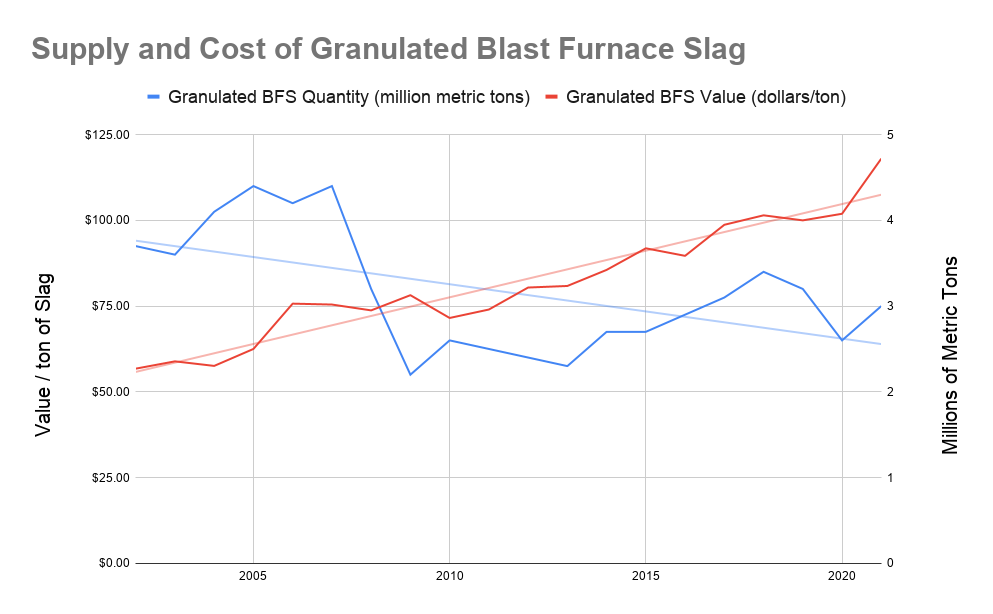
Granulated slag production and estimated market cost. Source: USGS Iron and Steel Slag Statistics and Information page.
Why Fly Ash and Slag Shortages Matter
For ready-mix producers, this creates a practical question:
What happens as the SCM supply continues to fall?
1) Higher Costs
Fly ash and slag have historically helped concrete producers lower costs by replacing cement with a cheap byproduct. But when supply tightens, producers often have to pay the same or more for a lower quality SCM supply.
2) Losing durability benefits
SCMs are not just fillers. Properly selected fly ash, slag, and pozzolans can help reduce permeability, improve long-term strength development, and improve concrete durability.
If a producer loses access to SCMs, the backup mix design is often a 100% cement mix. That may solve the short-term strength requirement, but it can increase cost, heat, shrinkage risk, and embodied carbon.
3) Higher environmental impact
Portland cement is the highest-carbon ingredient in concrete. The International Energy Agency identifies reducing cement consumption through supplementary cementitious materials as one of the key ways to reduce cement emissions. See the IEA’s page on cement.
That is why SCM supply is not just a purchasing issue. It is also a carbon, specification, and customer-retention issue. As owners and engineers ask for lower-carbon mixes and EPDs, concrete providers need reliable cement-replacement options.
The Solution
The only long-term solution is for concrete producers to get away from the old SCMs before the supply shortage and price hike hurt their business.
Possible alternatives include:
Ground-glass pozzolan
Natural pozzolans
Calcined clay
Harvested or beneficiated ponded fly ash
The most practical option for many markets is Ground Glass Pozzolan (GGP). It is made by processing recycled glass into a fine powder that can react as a pozzolan in concrete. Ground glass pozzolan is covered by ASTM C1866 and is already approved by several regulator agencies including the New York State Department of Transportation (NYSDOT).
Concrete Producers Take Control
The most ambitious concrete producers are going one step further and becoming independent of the traditional pozzolan suppliers.

The Glass Pozzolan Manufacturing Process sold by KLAW Industries that is enabling concrete producer make their own glass pozzolans.
Glass is unique in that it is the only pozzolan that concrete producers can manufacture themselves. This allows for higher margins, a guaranteed supply, and a substantial competitive advantage over those buying from old sources. This is another reason for the material’s growing popularity.
The economics of manufacturing a glass pozzolan vary drastically by region, to learn the feasibility of your location go to the KLAW Industries Research Project Page.
To see the cost of a modular glass pozzolan plant, go to the KLAW Industries Plant Cost Calculator.